Raipur (Chhattisgarh) [India], October 16: Can one degree prepare a student to shoot a fashion lookbook, a tiger in the forest and a product on a white table? The photography course after 12th at AAFT University Raipur, a B.A. in Photography, builds that range into its programme. Students learn the lighting, camera control and editing that each kind of shoot demands, and then choose where to focus.
Photography looks simple from the outside, because almost everyone carries a camera phone. Paid work is different. A brand shoot, a wildlife assignment or a studio catalogue each has its own technical rules, client expectations and deadlines. A photography degree gives students time to learn those rules properly before they start charging for their work.
AAFT University of Media and Arts in Raipur, Chhattisgarh, offers the B.A. in Photography (three years, or four with Honours) and the two-year M.A. in Photography on its Kharora campus through the AAFT University School of Still Photography. Admissions for the 2027 batch are open.
Is a Photography Course After 12th a Good Career Choice?
For students with a strong visual sense and patience for technical detail, it can be. Demand for professional images is spread across weddings, e-commerce, advertising, media and social platforms. That spread gives photographers several ways to earn, rather than one employer type.
A photography course after 12th also suits students who want creative work with a practical, portfolio-based career path. Recruiters and clients usually judge photographers by what they have shot, so the degree years are a chance to build that body of work.
The Market in Figures
Photography sits inside India’s wider media and content economy. The figures below come from market research and industry reports, not from the university. The photography services estimates are from a single market-research firm and should be read as indicative.
| Indicator | Figure | Source |
|---|---|---|
| India photography services market, 2024 | About US$6.8 billion | Custom Market Insights |
| Projected market size, 2033 | About US$13.7 billion | Custom Market Insights |
| Expected growth rate, 2024 to 2033 | About 8.1% a year | Custom Market Insights |
| E-commerce and point-of-sale advertising, 2025 | Grew 50% to ₹220 billion | FICCI-EY 2026 |
| Digital media’s position in Indian M&E | Over ₹1 trillion, the biggest single segment | FICCI-EY 2026 |
E-commerce advertising grew 50% in 2025, and every product listing and campaign needs professional images. Digital media is now the largest part of Indian media, and digital platforms run on images. Together, these point to steady demand for people who can produce professional photographs.
Market growth does not guarantee any individual’s income. Earnings in photography vary widely with specialisation, city, clients and the strength of a portfolio.
Three Kinds of Shoot, Three Sets of Skills
The headline names three kinds of work because each trains a different part of a photographer’s skill. The curriculum covers all three, along with several other genres.
Fashion Shoots
What the work demands: Controlled lighting on people, styling coordination, posing direction and consistent colour across a series.
What students learn: Fashion photography at an advanced level, portrait lighting, advertising techniques and retouching in the digital darkroom.
Where it can lead: Fashion and lookbook shoots, brand campaigns, magazine editorials and e-commerce apparel catalogues.
Wildlife Shoots
What the work demands: Long lenses, fast shutter decisions, fieldcraft, ethics around animals and habitats, and patience outdoors.
What students learn: Wildlife, landscape and macro photography, exposure in changing natural light, and field planning.
Where it can lead: Travel and nature assignments, conservation projects, stock photography and editorial features.
Studio Shoots
What the work demands: Precise control of strobes and continuous lights, backgrounds, reflections and product detail.
What students learn: Studio lighting, advertising photography, product and food photography, and Capture One, which is widely used for tethered studio work.
Where it can lead: Product and catalogue work for brands and online stores, advertising agencies and commercial studios.
The Wider Curriculum
Beyond these three areas, the B.A. (Photography) syllabus listed by the university covers a broad set of subjects. They include the history of photography, visual theory, photojournalism, sports, event and wedding photography, architectural photography and fine art photography. Video editing and digital video are also taught, since many clients now ask photographers for short video content too.
Students choose between a three-year B.A. and a four-year Honours route, with an Honours with Research option that adds research methodology. This lets students decide how far they want to go before entering work or further study.
Editing Is Half the Job
Every professional image passes through editing before a client sees it. The programme trains students in Adobe Creative Suite for retouching and layout, and in Capture One, which many studios use for tethered shooting and colour-accurate processing. Canva Pro is also covered for quick social and marketing layouts.
The digital darkroom modules move from basic correction to advanced creative editing. Students learn colour management, skin retouching, compositing and preparing files for print and web. These are the steps that turn a good raw file into a deliverable image.
Studios, Equipment and Labs
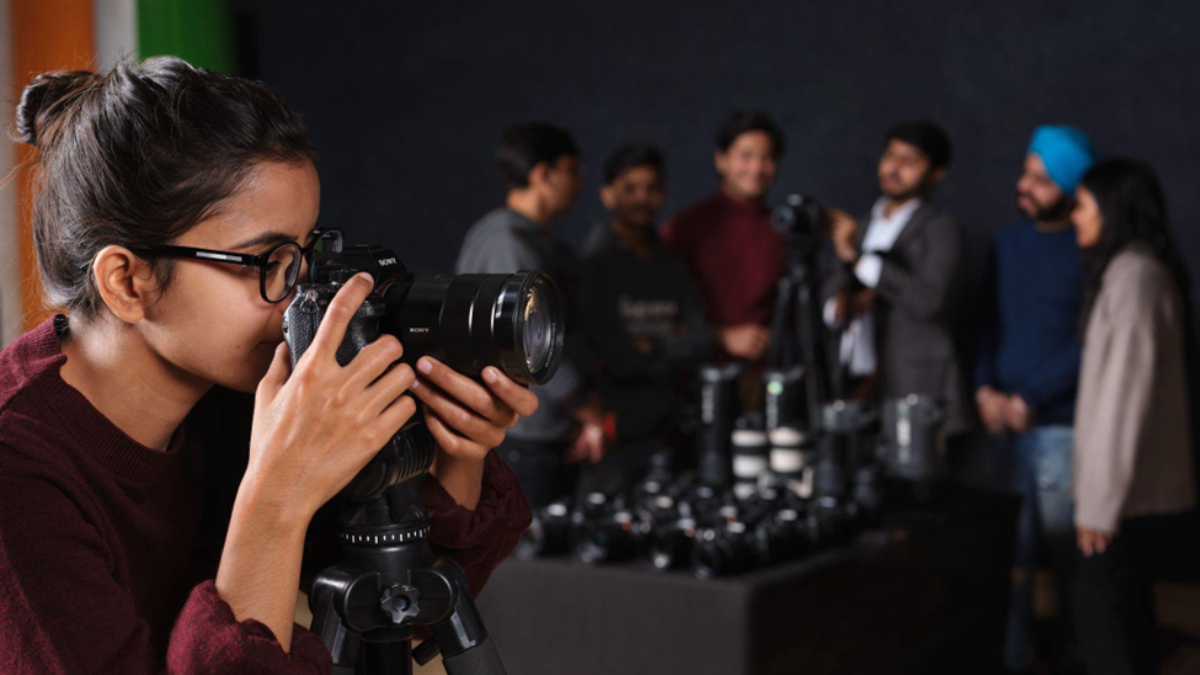
According to the university, students work in professional studios with lighting and camera equipment, along with editing labs equipped with iMacs and Windows systems. Studio work lets students practise lighting set-ups, while the wildlife, landscape and macro modules apply the same camera skills to natural light.
These resources support the photography course after 12th from its first semester, when students begin with the basics of camera handling and exposure.
Where the Course Begins
The foundation subjects listed in the syllabus set up everything that follows.
- Basics of Photography: camera handling, exposure, aperture, shutter speed and ISO
- History of Photography: how the medium and its visual language developed
- Visual Theories: composition, meaning and how audiences read images
- Digital Darkroom: file handling, correction and basic retouching
Light: The Skill Behind Every Genre
Whether the subject is a model, a leopard or a watch, photography is the control of light. In the studio, photographers shape light with strobes, softboxes and reflectors. Outdoors, they read the sun, clouds and shade and choose the right moment to shoot.
The course treats light as a core subject rather than a side topic. Students practise one-light, two-light and three-light set-ups, then learn to recreate similar effects with natural light. This habit of reading light carries across every genre they later choose.
How Technology Is Changing the Field
Mirrorless cameras, faster autofocus and higher-resolution sensors have changed how photographers work in the field and studio. Drones have opened aerial photography, but flying them commercially in India falls under the Drone Rules, 2021, which set out registration and pilot certification. Photographers who want aerial work need to understand these rules before taking paid assignments.
Editing has changed too, with AI-assisted tools now common in retouching software. These tools speed up routine tasks, but clients still pay for judgement about light, composition and story. That judgement is what the degree focuses on building.
Ethics, Consent and Copyright
Professional photography carries responsibilities as well as creative freedom. Photographers need consent to use images of people, especially in commercial work. Wildlife photographers must avoid disturbing animals or damaging habitats for the sake of a shot.
Copyright matters too. Photographers need to understand who owns an image, how licensing works and how to protect their work online.
Careers the Degree Can Open
The university lists a range of roles for graduates. Each draws on a different mix of the skills above.
| Role | Typical clients or employers |
|---|---|
| Fashion Photographer | Fashion labels, magazines, e-commerce apparel brands |
| Wildlife Photographer | Travel and nature publications, conservation groups, stock agencies |
| Product and Advertising Photographer | Brands, online retailers, advertising agencies |
| Photojournalist | News organisations and digital media outlets |
| Event and Wedding Photographer | Private clients and event companies |
| Fine Art Photographer | Galleries, exhibitions and print buyers |
| Travel Photographer | Tourism boards, travel brands and publications |
Many photographers combine two or more of these areas, especially in their early years. A wedding photographer may also shoot products, and a fashion photographer may take on editorial assignments.
Freelance or Salaried?
| Factor | Freelance photographer | Salaried photographer |
|---|---|---|
| Income pattern | Varies with projects and season | Regular monthly salary |
| Choice of work | Chooses clients and genres | Follows the employer’s needs |
| Business skills needed | Pricing, contracts, marketing | Fewer, mostly within a team |
| Equipment | Usually owns or rents gear | Often provided by the employer |
Many photographers begin as assistants or salaried staff to learn how professional shoots run. Some later move to freelance work once they have clients and a network.
Building a Portfolio That Wins Work
- A tight edit of strong images, not every picture taken
- A clear focus that matches the kind of work you want
- Evidence of lighting control in both studio and natural light
- At least one complete series, such as a lookbook or photo story
- A simple online presence where clients can view your work
Industry Dean: Rohit Chawla
The School of Still Photography’s Industry Dean is Rohit Chawla, a photographer with more than four decades of experience. According to the university, he began his career in advertising at JWT before founding his own design and film production company. His work is known for a minimalist, graphic style, and his exhibitions have been shown in museums and private collections.
For students aiming at fashion, advertising or studio work, an Industry Dean with this background links the syllabus to how commercial photography is actually commissioned and judged.
Faculty at the School of Still Photography
The school is headed by Mr. Rishi Manik Das, Head of Department. Assistant Professors Mr. Arpit Agrawal, Mr. Dibyojyoti Mitra, Ms. Namrata Chandrakar and Mr. Rahul Shakya teach across studio, field and editing subjects. More programmes are listed on the AAFT University School of Still Photography page.
From the President’s Desk
Dr. Sandeep Marwah, President, AAFT University, said: “A photograph is judged in a second, but it takes years of practice to make that second count. Fashion, wildlife and studio work each teach a photographer something different, whether it is directing people, waiting for nature or controlling every reflection. We want our students in Raipur to learn all three, find the work that suits them, and graduate with a portfolio that shows it.”
Taking It Further with an M.A.
Graduates who want deeper specialisation can continue with the two-year M.A. in Photography, run by the same school. Its published four-semester curriculum adds specialised genres such as astro, infrared, aerial, forensic and sports photography. It also covers advanced post-production, digital video and research methods, and the final semester is built around a portfolio project and a dissertation.
Admissions Snapshot
Programmes: B.A. (Photography), 3 years or 4 years Honours; M.A. (Photography), 2 years
Undergraduate entry: After Class 12
Selection: AAFT Global Entrance Exam and interview
Industry Dean: Rohit Chawla
Campus: Kharora, near Raipur, Chhattisgarh
Intake: 2027 applications open
Frequently Asked Questions
Does the university provide camera and lighting equipment?
The university lists professional studios with lighting and camera equipment among its facilities.
Is a phone enough to become a professional photographer?
Phones are useful, but client work usually needs interchangeable lenses, lighting control and professional editing.
Which editing software is taught?
Adobe Creative Suite and Capture One, with Canva Pro for quick layouts.
Who is the Industry Dean for photography?
Photographer Rohit Chawla is Industry Dean of the School of Still Photography.
Can I specialise in only one genre?
Students cover many genres first and can then focus their portfolio on the area they prefer.
Can I study photography if I was in the science or commerce stream?
Yes. The undergraduate programme is open to students after Class 12, and a portfolio or strong visual interest helps more than the stream studied.
Will I learn video as well?
Yes. Video editing and digital video are part of the curriculum.
Is there a specialisation in wildlife photography?
Wildlife, landscape and macro photography are covered as part of the genres taught.
What is the difference between the three-year and four-year routes?
The four-year Honours route adds a further year of study, with an option for research.
About AAFT University
AAFT University is located at Kharora near Raipur and is part of the AAFT group, which has worked in creative education for over three decades. Its School of Still Photography teaches through studios, field assignments and editing labs. Alongside photography, the university runs programmes in media, arts and design.
For Admission and Media Inquiries, Contact:
AAFT University
Vill. Manth, Kharora, Raipur, Chhattisgarh 493225, India
Phone: +91-9109112078 / +91-8064057209
Website: www.aaft.edu.in
Sources: Custom Market Insights, India Photography Services Market (2024–2033); FICCI-EY Media and Entertainment Report 2026 (March 2026).
If you object to the content of this press release, please notify us at pr.error.rectification@gmail.com. We will respond and rectify the situation within 24 hours.